Posts

Showing posts with the label Forcemeat

Galantine & Ballotine

Image
  Galantine Chicken Galantine   A galantine is an elaborate preparation that dates back to 17th century France. They were originally prepared by deboning a whole chicken, then combining its meat with minced veal, truffles, pork fat and other ingredients, plus a lot of seasonings, to make what's  called a forcemeat , and then stuffing this forcemeat into the skin of the chicken. It was then tied up, wrapped in bacon and  poached  in a rich stock that would eventually jell when cooled. The idea is very similar to the way foods were preserved in  aspic  or  confit . Indeed, like the aforementioned dishes, galantines were typically served cold, accompanied by the cold gelatinized stock and garnishes such as truffles, pistachios, and bacon. Galantines were originally made specifically from chicken. (If you speak Spanish, you know that the word  gallina  means hen, and the words come from the same root.) But eventually the technique ...
Ham, Bacon & Gammon

Image
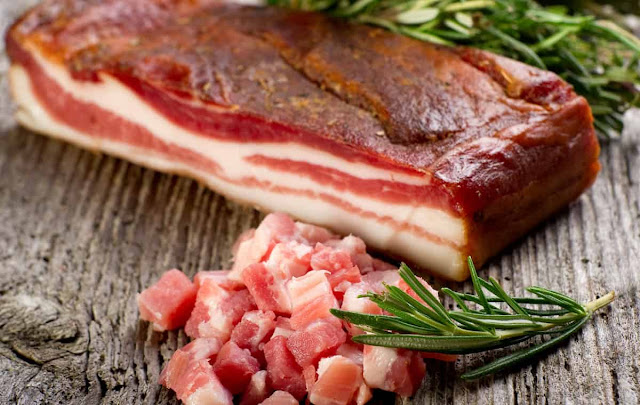
         Ham, Bacon & Gammon Ham Ham is the cured hind leg of a pig, smoked or salted and smoked to preserve it. Ham that are dry salted has the best flavour and are the most tender but other hams are plunged straight into brine, or cured in a way that combines both methods. Curing time can as long as 2 months. Salt used for curing is usually mixed with sugar an assortment of spices, particularly pepper and with nutritive preservatives that add Pink colour and protect meat from botulism toxins. The feed given to the Pig affects the taste of ham, the peanuts of virgin, and the peaches of Georgia; all contribute to flavour & texture. After salting the ham may be smoked over fragrant woods such as apple, beech and hickory, then it is left to age for 3 months to 2 years. The atmosphere must be cool and dry, many famous ham’s are cured in mountain regions. A cured ham (often called a Country or home cured ham) may weigh as much as 20 lb but small ...

Differences Between Paté - Terrine, Galantine - Ballotine; & Mousse - Mousseline

Image
 Differences Between:   Paté -  Terrine Galantine -  Ballotine Mousse -  Mousseline   Assorted -  Cold Meat Platter  Paté -  Terrine Sr. No. Paté Terrine 1 Paté is lined with pastry casings Terrines are lined with pork fat 2 Derived from French word which means ‘paste’ Derived from Latin word ‘terra’ meaning earth. 3 Forcemeat used in Pate is finely chopped or pureed In this the forcemeat is slightly coarse 4 In this liver is used as main ingredient E.g. Paté de foie gras Various forcemeat can be used and layered one over the other 5 Baked in rectangular mould Cooked in double boiled in an oval earthenware dish 6 Sliced and served Served sliced or are scooped with spoons 7 Demoul...

Sausage Fillings

Image
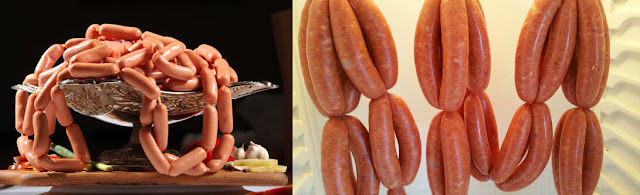
  Sausage Fillings   Sausage fillings Sausages have many varieties in filling and they are as below:   Coarse Minced Forcemeat: ·          Usually the ratio is 3 parts of meat and 1 part of fat (belly fat). Good quality of meat i.e. prime cuts is used in production of coarse minced force meat. Example: Salamis. ·          This filling is slightly coarser. ·          Minced with blades: Ø   Small blade – fine mincing. Ø   Big blade – coarse mincing. ·          Buffalo chopper is also used. ·          Used in salamis and mortadella.   Cutter Pulverised:        ·          5 parts of meat and 3 parts of fat. ·          2 parts ...

Forcemeat: Its types

Image
  Forcemeat: Its types   The term Forcemeat or farce, is used to describe the basic mixture that needs to be prepared in order to produce charcuterie products. The word farce comes from the Latin farcire.  A farce or forcemeat is a ground seasoned mixture of meat, game, poultry, fish or vegetables, prepared as a dish on its own or used to stuff other numerous other items such as eggs, meat, fish and poultry, pastry shells and perhaps even pasta.   Such dishes are prepared in the Garde Manger. Forcemeats are used in the preparation of a various cold dishes such as pate, terrines, galantines, ballotines, quenelle, roulade, mousse and mousseline.   Forcemeat: A key Component in the Art of Sausage Making   There are five primary types of forcemeat: ·         Campagne (Country Style) ·         Straight Method ·         Gratin Style ·  ...

Forcemeat: A Brief Introduction

Image
  Forcemeat   Forcemeats: The term Forcemeat or farce , is used to describe the basic mixture that needs to be prepared in order to produce charcuterie products. The word farce comes from the Latin farcire .  A farce or forcemeat is a ground seasoned mixture of meat, game, poultry, fish or vegetables, prepared as a dish on its own or used to stuff other numerous other items such as eggs, meat, fish and poultry, pastry shells and perhaps even pasta. Such dishes are prepared in the Garde Manger.  Forcemeats are used in the preparation of a various cold dishes such as pate, terrines, galantines, ballotines, quenelle, roulade, mousse and mousseline.   ·          Pate: from the old French paste, meaning paste. ·          Terrine: from the Latin Terra, meaning earth. ·          Galantine: from the old French galant, meaning gorgeous o...